
How to fix buckled, rippled, or torn carpet without replacing the whole room
Carpet Re-Stretching and Carpet Patching
Carpet re stretching, also written as carpet re-stretching, is the process of pulling a loose, buckled carpet back to its original tension and securing it firmly to the tack strips along the room's perimeter. When done correctly with a power stretcher, the result is a flat, stable floor surface with no ripples, raised seams, or buckling. Most rooms take a professional one to two hours to complete. This article explains how the process works, how it compares to knee-kicking, what carpet patching involves, and what homeowners should realistically expect when the job is finished.
The good news is that ripples and buckles don't mean your carpet is ruined. In most cases, the carpet itself hasn't failed; it has simply lost the tension that was holding it flat. That tension can be restored, and re-stretching is often less expensive than replacement, as long as the backing is still sound.
Key takeaways
- Power stretcher is essential: A knee kicker alone cannot remove room-wide ripples. Industry guidance specifies 1 to 1.5 percent stretch in each direction, and only a power stretcher delivers that consistently.
- Delamination disqualifies stretching: If the carpet backing is separating, crumbling, or ripples return within days of a stretch, the problem is structural and stretching will not hold.
- Patching handles damage stretching can't fix: Burns, tears, and pet damage that cuts into the backing requires a patch, not a stretch.
- Professional timing is predictable: One room runs one to two hours; a whole home is typically done in a day.
- Results are immediate: There is no drying or curing period after re-stretching. The floor is walkable the same day.
- Combining services saves disruption: Scheduling a cleaning and a carpet re stretching appointment together means less time, less coordination, and floors that look and perform better from day one.
What causes carpet ripples, and what does carpet re stretching fix?
Carpet buckles and ripples for several well-documented reasons. Improper installation using a knee kicker instead of a power stretcher is one of the most common culprits. Heavy furniture dragged across the surface, high humidity causing the backing to expand, and years of foot traffic gradually loosening the grip on the tack strips are other frequent causes. None of these problems mean the carpet itself is damaged; they mean it has lost tension.
Carpet re stretching fixes tension-related problems directly: ripples running across open floor areas, edges that have pulled free from the tack strip, and low spots that create tripping hazards. What it does not fix is worn fiber, permanent crushing, tears, burns, or stains. If the ripples come from delamination, the backing physically separating from the face fiber, stretching will not hold. The problem has to be identified correctly before any work begins, and a quick inspection of the backing tells a professional almost everything they need to know.
Signs you need carpet re stretching
Look for ripples or waves running across open floor areas, edges that have lifted away from the wall, low spots where the carpet shifts underfoot, or seams that have begun to gap. Any of these conditions is a signal to get the carpet assessed before the problem worsens.
Power stretching vs. knee kicking: what's the real difference?
A power stretcher is a mechanical tool that spans the width of a room, bracing against one wall while applying lever-driven tension toward the opposite wall. The head grips the carpet backing and pulls it in a controlled, even direction. Industry guidance specifies approximately 1 to 1.5 percent stretch in each direction, applied in overlapping passes roughly two head-widths apart. This distributes tension evenly across the entire surface and creates a uniform, durable result.
A knee kicker is a short tool that uses your knee to drive the carpet a few inches at a time. It works well for tight spaces: corners, closets, doorways, and short runs near a wall. For a room-wide ripple problem, a knee kicker simply cannot generate enough consistent force. Using one as the primary stretching tool is one of the most common reasons ripples return within months of an installation or repair. A power stretcher is not optional for whole-room carpet re-stretching.
Tool Best use Adequate for room-wide ripples? Rent or buy? Power stretcher kit Full-room tension restoration Yes Rent for one-time use Knee kicker Corners, doorways, edge work No Rent or buy Carpet tucker / stair tool Tucking edge into tack-strip gap N/A Buy Carpet knife / utility knife Trimming excess carpet N/A Buy Pliers Lifting carpet from tack strips N/A Buy
For a DIY project,
the practical purchase list is straightforward: utility knife and blades, pry bar, pliers, a carpet tucker, a hammer, tape measure, and safety gear. Rent the power stretcher, and rent the knee kicker unless you plan to keep one for future work. Current example pricing places a power stretcher kit around $35 to $55 per day, according to goodcarpetguide.com, with a knee kicker running $12 to $24 per day at similar rental outlets.
What the re-stretching process looks like from start to finish
The process begins with clearing the room and inspecting the carpet thoroughly before any tool touches it. Furniture is removed or moved in sections. Existing tack strips are checked for stability, loose strips are replaced, and padding is flattened or refastened if it has shifted. The carpet edge is then pulled free from the tack strips along the working wall using pliers or a flat tool, with care taken to avoid tearing the backing.
The power stretcher is set up with the tail block braced against a protected baseboard and the head positioned near the opposite wall. Tension is applied gradually through the lever, working in overlapping sections. As each section is stretched flat, the carpet is immediately pressed back onto the tack strip to hold the tension. The knee kicker handles final positioning into corners. Once the entire perimeter is re-secured, excess carpet is trimmed from the back side and tucked neatly into the tack-strip gap.
At doorways, the transition strip is removed before stretching begins and reinstalled only after the carpet lies flat and tension is even throughout the room. Forcing a threshold strip down while the rest of the room is still loose can pull the doorway out of alignment or twist any seam running through it. Before the job is considered complete, confirm that no tack-strip pins are exposed at the edges and that door clearances are maintained.
Carpet patching: when re-stretching alone isn't the answer
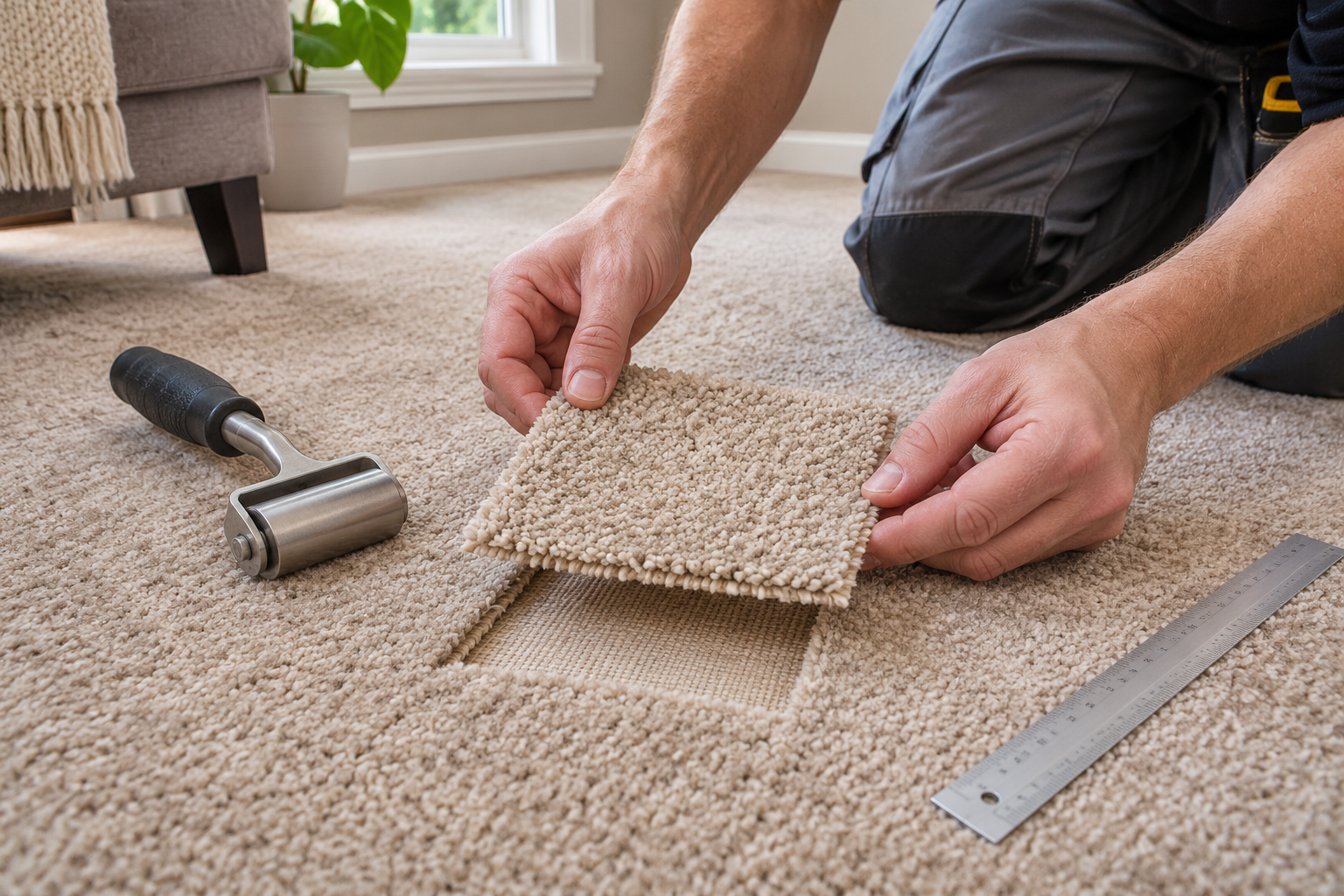
Some carpet damage goes beyond loose tension. Burns, tears, pet damage that cuts into the backing, or heavily worn traffic lanes all call for a patch rather than a stretch. A patch involves cutting out the damaged section in a clean geometric shape, sourcing a matching piece of carpet (ideally from a closet remnant), cutting it to fit precisely, and bonding it with seaming tape and a seaming iron so the edges lie flat and the pile direction matches.
The biggest factor in patch quality is pile direction and the match of the replacement piece. Carpet cut from the same roll and installed with the same nap direction is nearly invisible after the fibers settle. Mismatched dye lots or reversed pile direction will always show, regardless of how clean the cut is. A professional assesses the match before committing to the repair. In cases where no matching material exists, partial room replacement may be a more practical option than a visible patch.
The professional cutting technique matters as much as the material match. The blade must be held vertically through the pile and backing. An angled cut creates a V-shaped gap or ridge along the seam line that no amount of brushing will hide. After the patch is seated and bonded, a seam roller presses the backing flat, then neighboring tufts are teased across the joint and trimmed so the eye cannot follow the seam.
Time and cost: what to expect in 2026
A single room typically takes one to two hours for a professional. Three rooms run two to four hours. A full home with five or more rooms can usually be completed in a day, according to flooringclarity.com. DIY takes considerably longer, especially accounting for furniture handling, learning the tool, and re-doing any sections that don't come out flat.
Professional costs in 2026 generally run $100 to $300 per room, with many companies setting a minimum charge of $150 to $200, according to Angi's 2026 cost data. Complex stretching combined with seam repair can run $200 to $700 professionally, according to Angi. DIY becomes less economical when furniture moving is extensive, seams are involved, or damaged tack strips and padding need replacement.
The carpet is walkable immediately after a re-stretch. There is no drying or curing period, which makes the scheduling straightforward. Reserve two hours per room for planning purposes and a full day for an average whole-house job. These estimates cover re-stretching only; pad replacement, seam repairs, and patching add time.
DIY or professional: making the right call
DIY carpet re stretching is realistic for a homeowner with an empty room, a simple ripple problem, and the willingness to rent a power stretcher and practice the technique. What makes the job harder than it looks is working around furniture, handling doorway transitions precisely, and knowing when to stop if the backing is showing stress. A botched stretch can create new ripples or damage the backing permanently, turning a small repair into a full replacement conversation.
Stop immediately if you hear tearing or cracking, or see backing separation, or cannot keep the stretcher anchored. If the backing is showing stress or ripples are caused by deteriorated padding, those conditions need repair or professional assessment, not additional tension. Bubbles that shift when pressed, chalky tan powder under a lifted edge, and ripples that return within days after stretching all point to delamination rather than simple tension loss.
Here is something most homeowners don't consider until after the fact: carpet that has been buckled often traps more soil in the loose folds, and carpet that has been professionally cleaned sometimes reveals ripples that weren't as obvious when the pile was dirty.
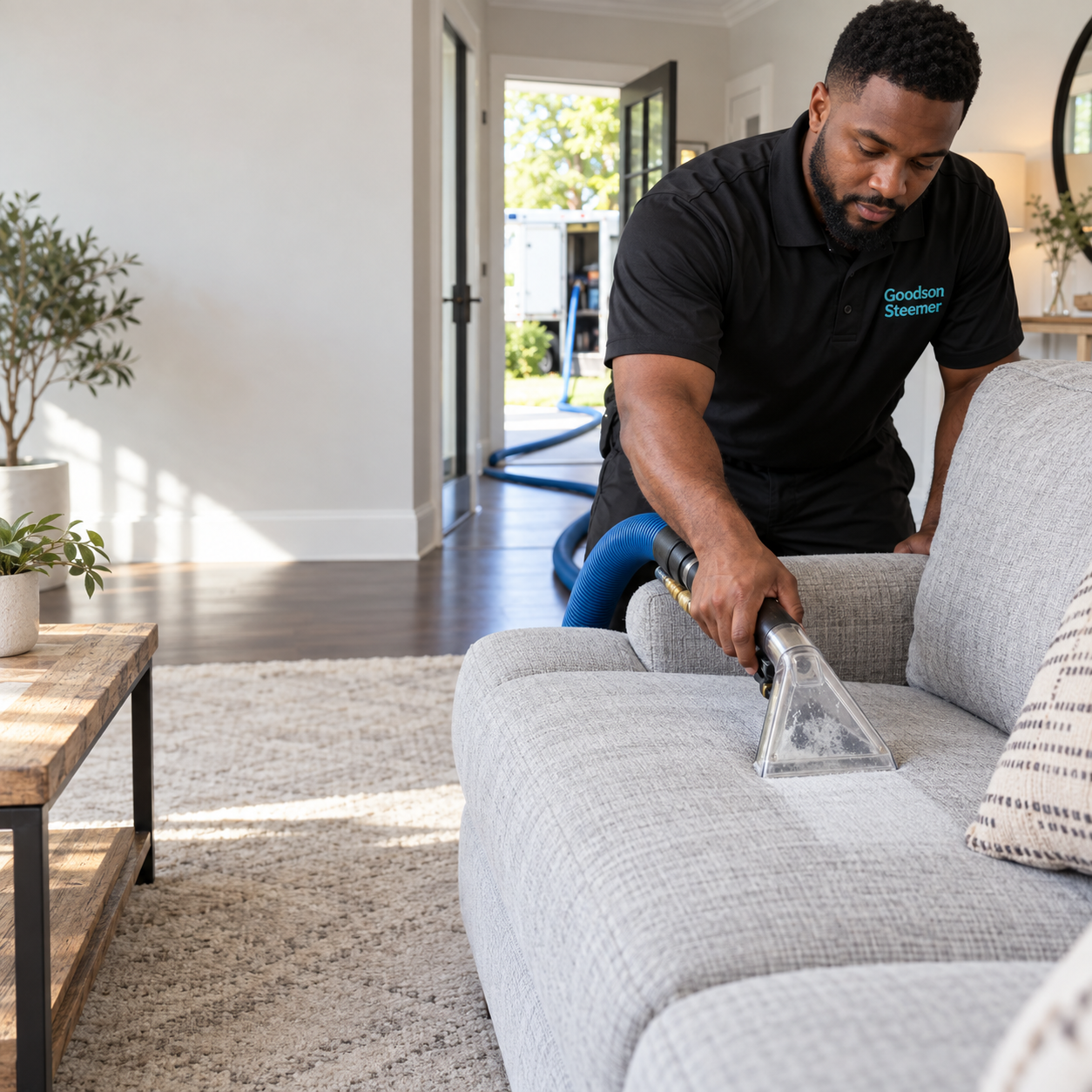
If you're dealing with both issues, finding a company that handles professional steam cleaning and carpet stretching under the same roof means one appointment, one phone call, and no coordinating between two different crews. Goodson Steemer offers carpet cleaning and carpet re-stretching services in Metro Detroit.
Your carpet can be smooth again
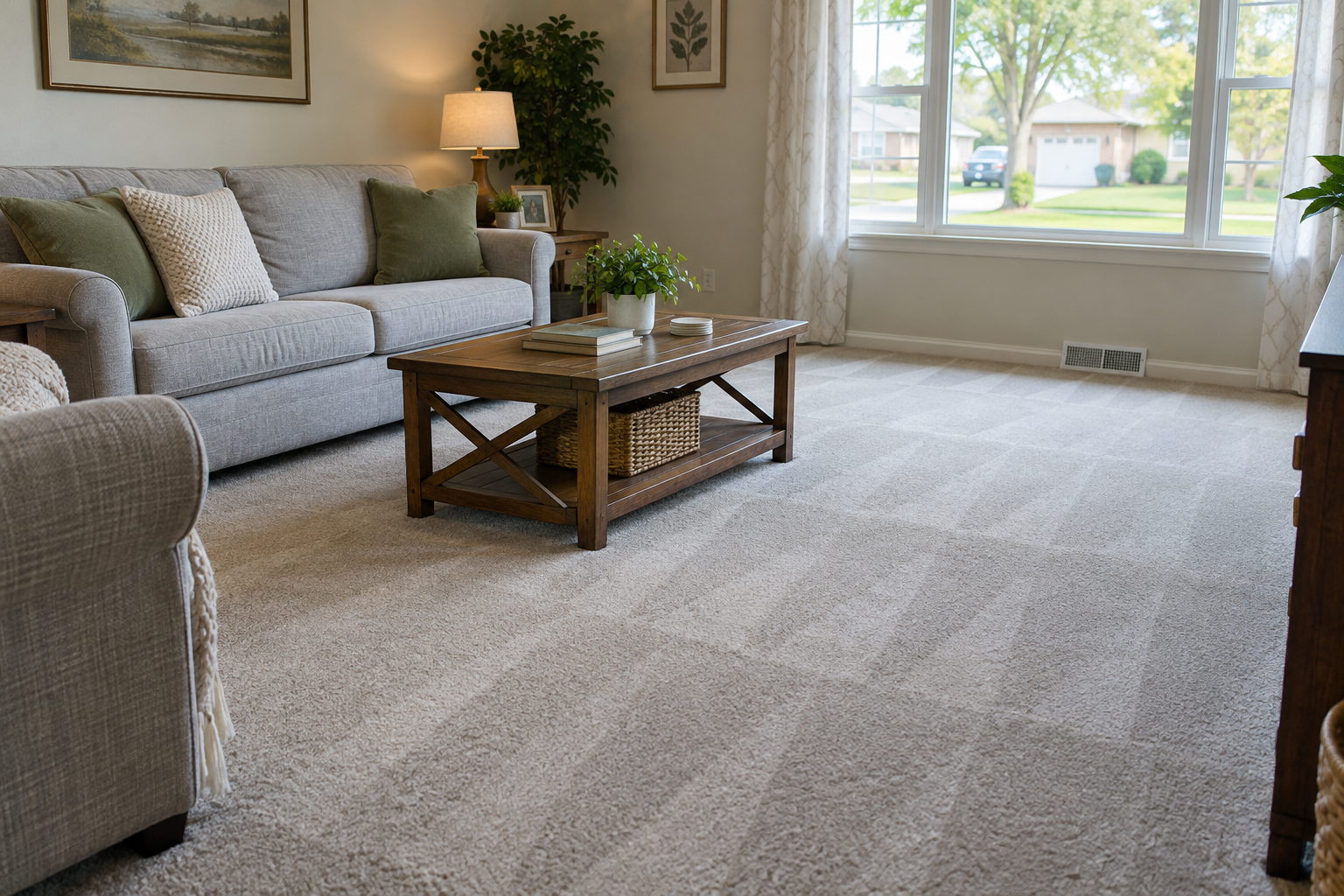
Carpet re stretching is one of the most cost-effective repairs a homeowner can make, especially compared to full replacement. The key is matching the right tool to the right problem: a power stretcher for room-wide ripples, a knee kicker for the finish work, and a patch for damage that stretching won't fix. Most rooms are done in a couple of hours and the results are immediate.
Before any work begins, lift a corner and check the backing. Sound, flexible backing with no chalky residue, no separation, and no hollow spots is a strong candidate for a successful re-stretch that lasts years. Brittle, crumbling, or separating backing is a signal to stop and get a professional assessment before spending money on a stretch that won't hold.
If you're in the Metro Detroit area and dealing with buckled carpet, persistent ripples, or damage that needs a professional eye, reach out to our team at Goodson Steemer. We'll assess the carpet honestly and tell you upfront whether a stretch, a patch, or something else is the right move for your floors.
Frequently Asked Questions
How soon can we walk on the carpet after re-stretching?
You can walk on the carpet immediately after re-stretching because there is no drying or curing period. This makes scheduling straightforward and lets you use the room the same day the work is completed.
How can we quickly tell if the carpet backing is suitable for stretching?
Lift a corner and inspect the backing: sound, flexible backing with no chalky residue, no separation, and no hollow spots indicates a good candidate for stretching. Brittle, crumbling, or separating backing signals delamination and means you should stop and get a professional assessment before spending money on a stretch that won't hold.