
How to Remove Pet Odors from Carpet for Good
How to Remove Pet Odors from Carpet for Good
You walk through your front door after a long day, and you smell it before you see any evidence. The hallway carpet has that unmistakable warmth to it. You love your dog, genuinely, deeply, but right now you're standing in your entryway making a face you'd never make in public. For many pet owners, effective pet odor removal feels like a losing battle, because pet odor doesn't just sit on the surface waiting to be wiped away. It hides. It reactivates. It comes back after you thought you'd beaten it.
Many DIY attempts fail because they address the surface, not the source. That's not a knock on your effort. It's a chemistry problem, and once you understand it, the solution becomes much clearer. Here's everything you need to know, from the science behind why the smell keeps coming back to the exact steps that actually work.
Pet Odor Removal: Why Carpet Odors Are So Stubborn
The chemistry hiding below the surface
Pet urine contains uric acid, a nitrogen-based compound that doesn't dissolve easily in water. As urine dries, the water evaporates and the uric acid concentrates into microscopic crystals that bond tightly to carpet fibers, backing, and in most cases, the padding underneath. Standard household cleaners can temporarily mask the smell, but they leave those crystals behind intact. When humidity rises or the area gets wet again, the crystals reactivate and release odor compounds all over again. This is why a stain can seem completely gone on a dry winter day and roar back to life after you shampoo the carpet or during a humid Michigan summer.
Why scrubbing and surface sprays backfire
A common DIY response is to scrub the spot hard and blast it with a deodorizing spray. Scrubbing actually pushes urine deeper into the carpet fibers and padding, spreading the affected area wider. Deodorizing sprays work on the odor molecules sitting at the surface but leave the underlying uric acid crystals completely untouched. Until you neutralize the actual source of the odor, you're layering fragrance over a problem that hasn't been solved. Keep that in mind as you work through the methods below.
The right first response when the accident is fresh
Blot first, always
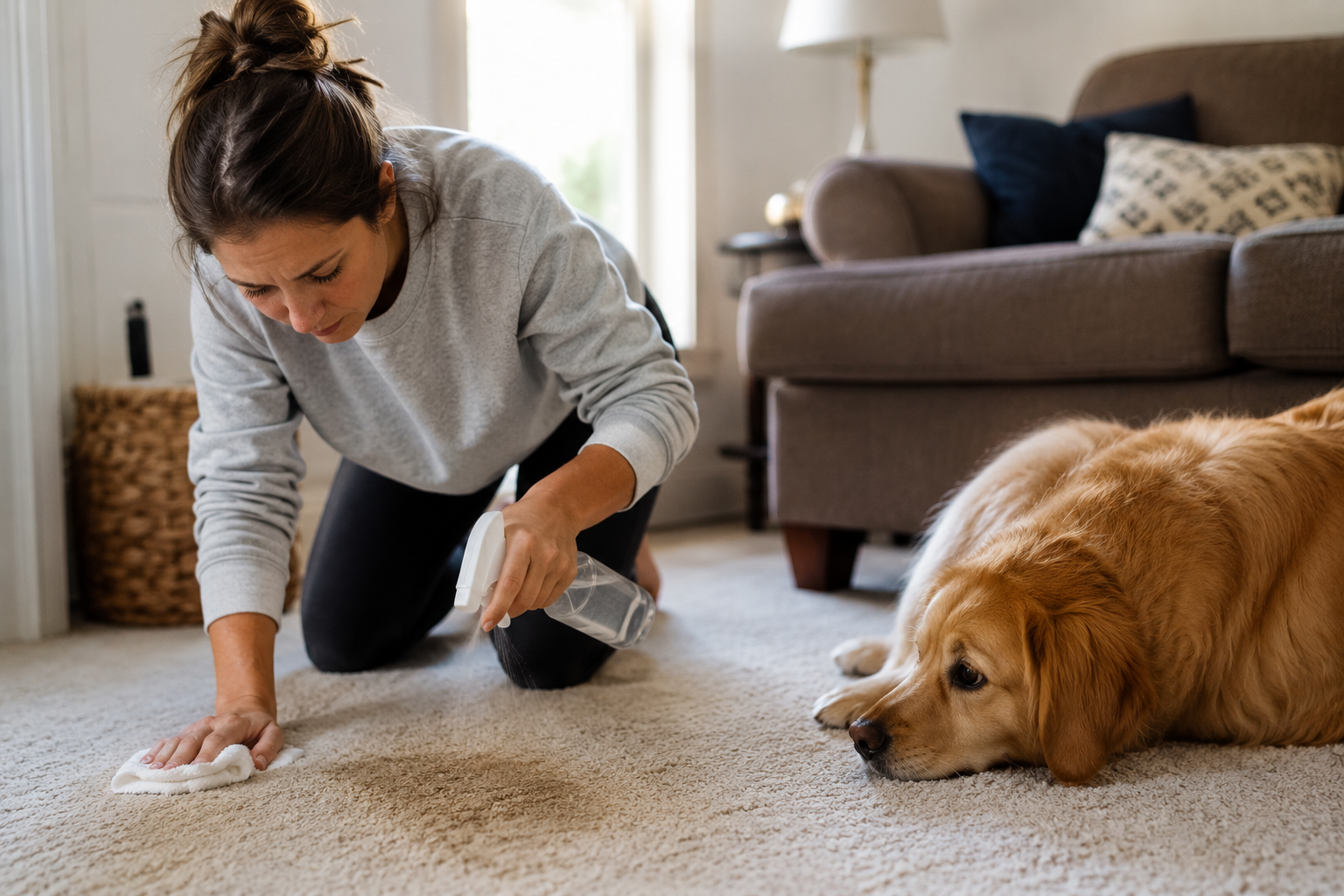
The single most important immediate step is blotting, not rubbing. Grab clean paper towels or a white cloth, press firmly into the spot, and lift straight up. Repeat this until the towels come away barely damp. Removing as much liquid as possible before you apply any cleaner dramatically improves what happens next. Skipping or rushing past this step is one of the most consistent reasons DIY pet odor removal treatments don't hold.
Baking soda and white vinegar: helpful, not complete
A vinegar-water solution (equal parts) applied after blotting can dilute remaining urine and reduce the immediate odor. Baking soda sprinkled once the area is mostly dry works as an odor absorber. Both are safe for most carpets and perfectly fine as a first pass on a fresh accident. But they come with honest limitations: some sources report that vinegar may actually attract pets back to the same spot, and neither ingredient breaks down uric acid crystals. Think of them as helpful opening moves, not a complete solution for pet odor removal from carpet.
Hydrogen peroxide: useful tool, real risks
A 3% hydrogen peroxide solution mixed with a small amount of dish soap can help lift stain residue and reduce odor on some carpets. The main risk is bleaching. Always spot-test in a hidden area first, because hydrogen peroxide can fade carpet dyes, especially on darker or patterned fibers. One more thing: never mix vinegar and hydrogen peroxide together. That combination creates peracetic acid, a stronger irritant that requires ventilation and gloves. Use them separately, not as a combined recipe.
Why enzyme cleaners are the best-supported solution for pet urine odor
How enzyme cleaners actually work
Enzyme cleaners don't mask odor, they eliminate it at the source. They contain biological enzymes, specifically proteases, lipases, and uricase, that break down the organic compounds in urine at a molecular level, including those uric acid crystals that everything else leaves behind. Once those compounds are broken down, the odor source is eliminated rather than temporarily suppressed. This is why enzyme-based products consistently outperform standard cleaners and why professional carpet technicians rely on them as a baseline tool, not a premium add-on. For most pet urine situations, a quality enzyme cleaner is the most effective pet odor eliminator you can buy.
Products worth knowing about
If you're standing in the cleaning aisle feeling overwhelmed by options, here's a short, evidence-based list to work from. Rocco & Roxie Professional Strength Stain & Odor Eliminator is the most consistently recommended product in published roundups and review site testing for deep-set carpet odors. Nature's Miracle Advanced Stain and Odor Eliminator showed a 93% reduction in detectable ammonia in published hands-on tests. Bissell Professional Pet Stain and Odor Removing Formula is the top overall pick in Good Housekeeping's expert testing. Any of these will give you a meaningful starting point for urine odor removal at home.
The step most people skip: dwell time
Apply your enzyme cleaner generously enough to reach the carpet backing, not just the surface fibers. Then leave it alone. For fresh stains, a minimum of 10 to 15 minutes is needed; for set-in or heavy contamination, some products call for 8 hours or overnight contact. Covering the treated area with a damp towel prevents the solution from drying out before it finishes working. Dwell time is where the chemistry actually happens, and skipping it is the single biggest reason enzyme cleaners seem like they "didn't work."
Treating old, dried-out pet odors that have been sitting for weeks
Finding hidden spots you didn't know about
Old, dried urine is invisible in normal light. A UV black light, inexpensive and available at most hardware stores, reveals urine deposits that glow under the beam. Walk through every carpeted room at night with the main lights off and mark each spot with painter's tape before you start treating. Many homeowners find odor sources in rooms they believed were clean. You can't treat what you can't find, and this step alone can explain why a whole room smells even when you've already cleaned a few visible spots.
Why old stains need a different approach
Dried uric acid crystals need to be rehydrated before an enzyme cleaner can interact with them. Lightly dampen the area with clean water first, then apply the enzyme cleaner. The goal is to reactivate those dormant crystals so the enzymes have access to them. For stains that have soaked into the padding, you need to saturate the carpet more aggressively so the cleaner actually reaches the layer where most of the odor-causing material lives. A light surface spray on a six-month-old stain will accomplish very little.
Step-by-step treatment for old, set-in odor
Here's the sequence that gives you the best shot at a permanent result:
- Lightly dampen the old stain with clean water to rehydrate the uric acid crystals.
- Apply enzyme cleaner generously so it penetrates through the fibers and into the backing.
- Cover the area with a damp cloth to prevent the solution from drying prematurely.
- Allow a minimum of 8 hours, ideally overnight, for full dwell time.
- Blot and extract with a wet/dry vacuum or clean towels.
- Sprinkle baking soda over the damp area and let it sit for a few hours.
- Vacuum thoroughly.
For heavy contamination, plan to repeat this process a second time. That's not a sign the method failed, it means the original staining was deeper than one treatment could fully reach.
Pet Odor Removal: When to Call a Pro
Signs the odor has moved past what DIY can reach
Some situations are genuinely beyond what consumer-grade cleaners can address. If urine has saturated the carpet padding and reached the subfloor, no enzyme spray applied from above will fully eliminate the source. The same is true for multi-pet households with years of accumulated odor, or for areas that have been treated repeatedly with the wrong products and now have deeply embedded residue. If your UV light reveals a whole room worth of staining and you've already done two or three rounds of proper enzyme treatment without lasting results, the contamination is likely below the carpet surface, and that's where professional equipment becomes genuinely necessary.
What professionals do that home treatment cannot replicate
Professional cleaners use truck-mounted hot-water extraction equipment that flushes and removes contaminated material from carpet fibers, backing, and padding at a level no rental machine can match. For serious pet odor cases, technicians perform sub-surface flushing: the affected area is saturated with a cleaning solution, then extracted repeatedly until the recovered water runs clear, pulling uric acid residue out from multiple layers at once. Rental units simply don't have the suction power, water temperature, or extraction capacity to do this effectively.
Enzyme treatment as a standard, not a line item
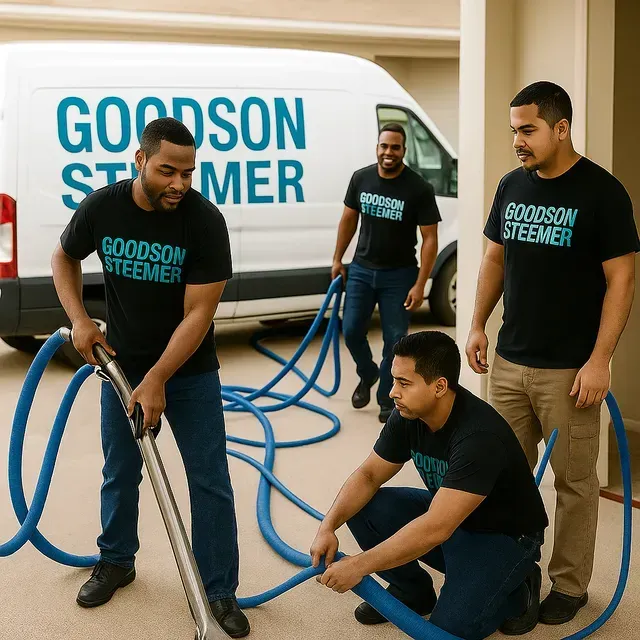
At Goodson Steemer, a locally owned carpet cleaning service in Livonia, pet odor jobs are treated differently than a one-size-fits-all approach. They serve Metro Detroit and surrounding communities with a process that includes enzyme treatments as part of every appointment, not an add-on with a separate charge on the invoice. For homeowners who have already spent money on multiple rounds of DIY pet odor removal products without lasting results, a thorough professional cleaning often turns out to be the more cost-effective call. The math is straightforward: new carpet costs far more than a professional cleaning, and a professional cleaning done right can extend carpet life by years.
Habits that keep pet smells from coming back
A cleaning schedule that actually works for pet households
Carpets in pet households need more attention than standard advice suggests. Vacuum high-traffic and pet-resting areas at least twice a week to remove dander, hair, and surface debris before it works deeper into fibers, and address accidents immediately using the blot-first method every single time, without exception. Schedule professional cleaning at least once a year, or every six months if you have multiple pets, to stay ahead of the gradual buildup that quietly turns into whole-room odor over time.
Air purifiers as an ongoing defense
A HEPA filter combined with a substantial activated carbon layer is your best air quality tool in a pet household. HEPA handles airborne dander and allergen particles; activated carbon targets the odor-causing gases that HEPA alone cannot capture. The size and quality of the carbon layer matters: thin carbon filters offer limited odor control, while units with a deeper carbon bed perform meaningfully better. One important note: avoid ozone-generating units entirely. Ozone is a lung irritant and is not safe for pets or people, regardless of what the marketing claims.
A final word on keeping it real
Pet odor removal is a process, not a one-time event, and that's okay. The right sequence matters more than any single product. Blot fresh accidents immediately, use a quality pet odor eliminator with enough dwell time to do its job, and don't underestimate how far urine travels below the carpet surface. When DIY treatment reaches its limit, professional cleaning with enzyme treatment is a practical and often surprisingly affordable path to a genuinely fresh home. If you're ready to get rid of pet smell for good, it starts with understanding the source and working through the right steps in order.
Your pets aren't going anywhere. With the right approach, your floors don't have to announce that the moment someone walks through your door.